
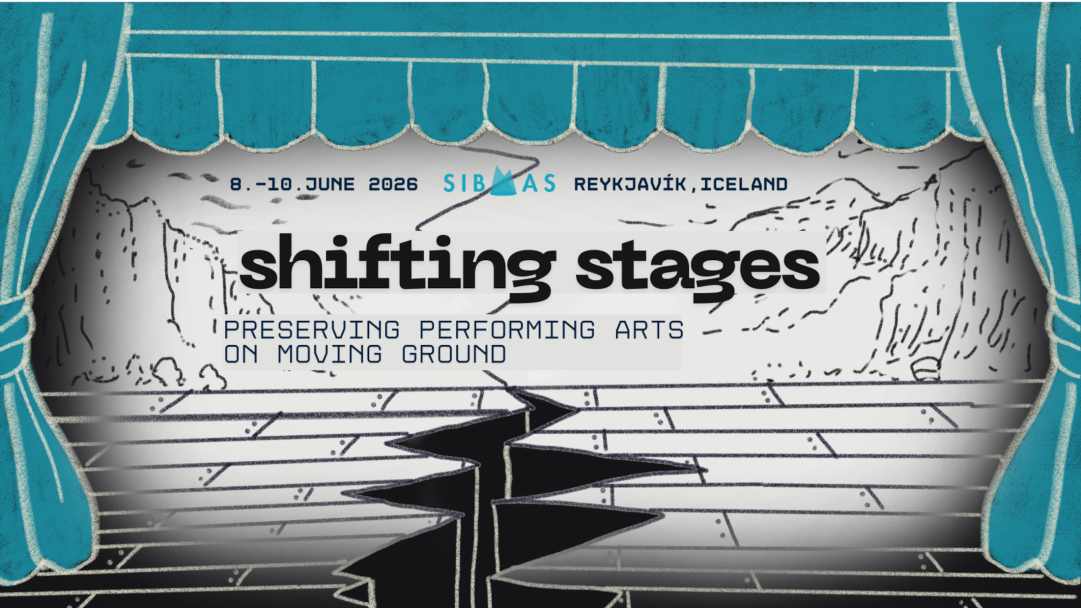
Shifting Stages, Shifting Sources: SIBMAS 2026 in Reykjavík
By A.M. LaVey / Theatre Library Association Liaison to the International Association of Libraries, Museums, Archives and Documentation Centres of the Performing Arts (SIBMAS)
The 2026 SIBMAS Symposium, held in Reykjavík, Iceland, from June 8 to 10, brought together performing arts archivists, curators, librarians, and researchers from the Americas, Europe, and Asia to consider what it means to preserve performance on moving ground. Hosted by the Theatre Archive at the National and University Library of Iceland, with Sigríður Jónsdóttir, Performing Arts Specialist at Landsbókasafn Íslands – Háskólabókasafn, as a key host and organizer, the symposium took place at Árnastofnun, the Árni Magnússon Institute for Icelandic Studies, and Þjóðleikhúsið, the National Theatre of Iceland.
The conference theme, “Shifting Stages: Preserving Performing Arts on Moving Ground,” offered an apt frame for a field defined by instability. The performing arts are fleeting, but the work of archives, libraries, museums, and documentation centers helps preserve their traces, contexts, and afterlives. Across papers, roundtables, posters, and site visits, participants considered dance, theatre, music, circus, costume, performance photography, audiovisual heritage, digital traces, web archives, born-digital collections, and the cultural infrastructures that allow performance memory to endure.
The opening remarks emphasized the changing ground beneath performing arts documentation. Sigríður Jónsdóttir and National Librarian Örn Hrafnkelsson welcomed participants by underscoring the importance of building and renewing professional connections in a field where preservation questions are never abstract. SIBMAS Presidents Nic Leonhardt and Alan R. Jones extended this frame by situating technological change within a longer history of uncertainty and adaptation. Jones’s remarks were especially resonant in relation to artificial intelligence: AI is neither fantasy nor apocalypse, he suggested, but one more instance of technological change that requires ethical judgment, professional responsibility, and human review. Documentation and cataloging are never purely technical activities; they are interpretive practices. That reminder would echo throughout the symposium.
The first day, held at Árnastofnun, foregrounded questions of documentation, technology, and archival methods. Yassaman Khajehi’s presentation on contemporary performative rituals reflected on fieldwork experiences and the archival challenges of documenting ongoing ritual practices. Stefán Þór Þorgeirsson, standing in for Fridthjófur Thorsteinsson, presented “Shifting Histories: Preservation in Motion,” considering preservation through the lens of movement and historical change. Melissa Wertheimer’s “Crawl, Don’t Run” examined how web archives can support contemporary performing arts documentation and research, a particularly urgent question as performance discourse, publicity, and reception increasingly circulate online rather than in stable print formats.
A central feature of the day was the roundtable “Digital Futures: AI, Innovation, and the Performing Arts Collections,” moderated by Alan R. Jones, with presentations by Clarisse Bardiot, Doug Reside, Thomas Thorausch, and Susanne Foellmer. The discussion avoided both technological utopianism and simple rejection. Instead, it asked how artificial intelligence might assist with discovery, data extraction, clustering, and intellectual control while also raising questions about labor, ethics, environmental cost, interpretive authority, and the risk of reproducing archival invisibilities.
Thorausch and Foellmer, drawing on the Deutsches Tanzarchiv Köln, asked what generative AI might mean for dance archives, especially in relation to dance reconstruction, canon formation, and the position of the body inside the data machine. Their presentation distinguished between the promise of AI for parsing scholarship and uncovering hidden dance history, and the more problematic fantasy that commercial AI can simply “reconstruct” performance. Bardiot’s presentation, “From Stage to Data,” focused on the digital archives of the Festival d’Avignon.
Using programs, images, and digital traces, she demonstrated how structured data, ontology, optical character recognition, multimodal document analysis, and image clustering can make new research questions possible across large collections. Reside’s presentation, “The Network in Our Stacks: Using Large Language Models to Extract Performance Data from Archival Documents,” examined experiments with extracting performance data from The New York Public Library’s theatre clippings and program files. His examples pointed to a problem shared across many performing arts repositories: historically rich legacy collections often remain difficult to search, describe, and use at scale. AI may help increase intellectual control, but only when guided by subject expertise and human review.
The roundtable discussion made clear that the ethics of AI in performing arts collections cannot be separated from labor, access, and power. Participants asked whether AI tools risk catering to capitalist systems, how moral boundaries might be drawn, and whether these technologies contribute to invisibility or might instead help surface marginalized subjects. One answer that emerged was balance: some research questions may not be possible without computational tools, but those tools require human judgment, archival ethics, and an awareness of what remains absent from the data.
The first day’s papers and posters further expanded the symposium’s geographic and disciplinary range. Frederieke van Wijk’s paper on power imbalance in circus collections addressed the human zoo and freakshow as ethically difficult archival subjects. Alexandra Beraldin examined the Festival d’Avignon through digital traces, while Morgen Stevens-Garmon discussed the papers of lighting designer Beverly Emmons at the Library of Congress, emphasizing the challenges of documenting a field shaped by continually evolving technology.
The poster session extended these questions across Miriam Althammer’s work on transnational gymnastics and embodied knowledge in modern Europe; André Felipe Costa’s project on Ibero-American queer theatre and sonic fiction; Eva del Rey’s work on archiving performing arts discourses; Nic Leonhardt’s research on performative cultures in Pahlavi Iran; Ana Perne’s work on Slovenian theatre audiovisual heritage; Harriet Reed’s collecting of independent music venues across the United Kingdom; Ana Wegner, Berilo Nosella, Elizabeth Azevedo, and Fabiana Fontana’s work on technical documentation in southeastern Brazil; and Katja Weingartshofer’s research on costume design and digital preservation.
Taken together, these presentations showed that “moving ground” is not one problem but many: technological, political, material, ethical, and disciplinary.
Day 2, held at the National Theatre of Iceland, turned toward the afterlives of performance and the evidentiary value of secondary sources. The roundtable “The Afterlife of Performance: Working with Secondary Sources,” moderated by Nic Leonhardt, brought together Anna Lawaetz, Libby Smigel, A.M. LaVey, and Dunja-Maria Münch. Across born-digital dance collections, dance writing, dance criticism, costume research, and hybrid archival acquisitions, the session asked what happens when the primary object of performance is unstable, dispersed, inaccessible, or missing altogether.
Lawaetz discussed born-digital and digitized material in a dance archive at the Danish Royal Library, including strategies for sorting an acquired collection that contained both physical and digital resources, such as CDs and floppy disks. Smigel argued for dance writing as a primary source in its own right: not only criticism, but witness, correspondence, blog posts, reader commentary, and community discourse. Her examples, including fan mail, Library of Congress blog posts, and letters to the editor, suggested that dance history is often built not only from official records but from communities of witness. LaVey’s presentation, “When the Reviews Disappear: Documenting Dance Criticism After the Clippings File,” examined the archival consequences of the decline of print dance criticism, the shifting role of clippings files, and the fragmentation of dance writing across digital platforms. Münch’s paper on costume research showed how the absence or fragility of costume objects requires scholars to reconstruct material histories through a network of secondary sources: drawings, advertisements, programs, letters, bookkeeping records, photographs, reviews, and related literary sources.
The roundtable’s discussion returned to questions central to performing arts librarianship and archival practice: how to collect underrepresented artists; how to document artists before their archives become institutional legacies, including the distinction between Nachlass collections formed after an artist’s death and Vorlass collections shaped during an artist’s lifetime; how to balance analog and digital collecting; and how to involve archival education in the formation of future collections. The session made clear that “secondary” sources are often anything but secondary. In the performing arts, they may be the only remaining evidence through which performance becomes legible after the event.
The day’s individual papers extended these concerns. Aliénor Fernandez’s presentation on Martine Franck and performance photography approached the archive as a kind of seismology, registering the tremors and afterimages of live performance. Daniela Lieb’s paper, with its memorable title on incorporating water-damaged theatre collections into a literary exhibition at a chronically understaffed institution “no-one has ever heard of,” brought both humor and urgency to the practical realities of exhibition-making under constraint. Laura Ars’s “Archiving as Human Work” returned to the relational foundations of collection-building: donors, trust, and care. Helena Hantáková’s presentations on the Prague Quadrennial situated performance memory within institutional histories.
A second Day 2 roundtable, “Crisis, Care, and Continuity in Cultural Collections,” moderated by Eva del Rey, shifted the focus from sources to infrastructures. Faiz Zahir, Dita Lánská, and Staf Vos considered how cultural memory is sustained when institutions are underfunded, politically pressured, or structurally incomplete. Zahir described performance memory in Bangladesh as increasingly preserved through grassroots practices, micro-archives, phone cameras, WhatsApp groups, and digital platforms. These informal systems can help communities bypass state monopolies and institutional absence, but they are not a sustainable substitute for cultural infrastructure. Lánská connected libraries and cultural institutions to democracy, labor, and political pressure, describing budget cuts, expanded workloads, declining salaries, and the importance of union organizing in cultural institutions. Vos described models for supporting artistic legacies in Flanders, balancing centralized memory institutions with decentralized support for artists, heirs, stakeholders, and service organizations.
The discussion that followed made one of the symposium’s most important points: crisis is often not an exception but the ordinary condition under which cultural workers attempt to preserve memory. Political instability, lack of heritage education, underfunding, changing governments, and weakened arts infrastructures all place pressure on cultural collections. Continuity often depends on individuals doing more than their formal mandates, and on fragile networks of care that can be disrupted when those individuals leave. Preservation, in this sense, is not only a technical problem. It is a labor problem, a political problem, and an ethical problem.
The symposium also included several opportunities for professional exchange beyond the formal papers and roundtables. The first day concluded with a reception at Iðnó, Reykjavík’s historic theatre, while the second day included the SIBMAS General Assembly, at which dance archivist Jane Pritchard was elected SIBMAS President. The forthcoming SIBMAS 2027 meeting in Prague was also previewed, extending the symposium’s attention from current archival challenges to future international collaboration. On the third day, programming organized in collaboration with Performing Arts Centre Iceland focused on the independent theatre scene in Iceland, including a conversation with writer and translator Salka Guðmundsdóttir, performer and director Aðalbjörg Árnadóttir, director Anna María Tómasdóttir, and Snæbjörn Brynjarsson, artistic director of Tjarnarbíó, Reykjavík’s home for independent performing arts. The afternoon included a staff-guided tour of the National Theatre and concluded with a closing reception at Bíó Paradís, Reykjavík’s art-house cinema, hosted by Fridthjófur Thorsteinsson, the well-known Icelandic lighting designer.
Across the symposium, the importance of subject expertise emerged again and again. Whether the topic was AI-assisted metadata extraction, dance criticism, costume reconstruction, web archives, circus collections, technical documentation, performance photography, or grassroots preservation, the central problem was rarely technical alone. Performing arts collections require people who understand the art forms, documents, communities, histories of description, and research practices that bring materials back into use. The symposium made especially visible the value of performing arts information specialists: professionals who move between collection care, cataloguing, archival description, digital access, donor relationships, scholarly interpretation, and public memory.
The 2026 SIBMAS Symposium offered a valuable international view of the questions currently reshaping performing arts libraries, archives, museums, and documentation centers. How do we describe legacy collections at scale? How do we document born-digital performance culture? How do we preserve websites, social media, and dispersed writing without mistaking access for stability? How do we collect underrepresented artists and communities without reproducing older imbalances? How do we use AI and other emerging technologies without surrendering professional judgment? And how do we sustain cultural memory when the infrastructures that support it are themselves unstable?
In Reykjavík, “moving ground” was more than a metaphor. It named the condition of the field itself. The performing arts archive has always been built from unstable materials: traces of live events, partial records, secondary accounts, dispersed collections, damaged objects, and fragile acts of memory. What this year’s symposium demonstrated is that this instability is not a weakness of the field, but one of its defining responsibilities. To preserve performance is to work with what remains, to attend to what is missing, and to build systems of access and care capable of carrying cultural memory forward.